Peer Review Process
1. Overview of the Peer Review Process
The journal applies a rigorous peer review process to ensure the academic quality, originality, relevance, and integrity of all published articles in the field of engineering science. Peer review serves as a critical mechanism for evaluating scholarly merit, improving manuscript quality, and maintaining high ethical and academic standards.
2. Type of Peer Review
The journal adopts a Double-Blind Peer Review system, in which the identities of both authors and reviewers remain anonymous throughout the review process. This approach ensures objectivity and minimizes potential bias.
3. Initial Editorial Screening
Upon submission, manuscripts undergo an initial evaluation by the Editor-in-Chief or an assigned editor to assess:
- Relevance to the journal’s scope
- Originality and scholarly contribution
- Academic and technical quality
- Formatting compliance
- Ethical standards and publication integrity
Manuscripts that do not meet these requirements may be rejected without external peer review.
All submissions are screened using Turnitin similarity reports. Excessive similarity, particularly from a single source, may result in rejection or requests for revision. The editorial office may also assess the inappropriate or undisclosed use of AI-generated content in accordance with the journal’s publication ethics policy.
4. Reviewer Selection and Assignment
Manuscripts that pass the initial editorial screening are assigned to two or more independent reviewers with expertise in the relevant discipline.
Reviewers are selected based on:
- Academic qualifications
- Subject expertise
- Research and publication background
- Absence of conflicts of interest
5. Review Criteria
Reviewers evaluate manuscripts according to the following criteria:
- Originality and contribution to knowledge
- Relevance to the field and journal scope
- Clarity of the theoretical and conceptual framework
- Methodological rigor and appropriateness
- Quality of analysis and interpretation
- Clarity, coherence, and academic writing quality
- Ethical compliance and research integrity
6. Reviewer Reports and Recommendations
Reviewers are expected to provide objective, constructive, and detailed feedback. Based on their evaluation, reviewers may recommend:
- Accept without revision
- Accept with minor revisions
- Major revisions required (Revise and Resubmit)
- Reject
7. Editorial Decision-Making
The editorial team evaluates reviewer reports and makes the final publication decision based on reviewer recommendations, manuscript quality, and alignment with the journal’s aims and scope.
In cases of conflicting reviewer opinions, additional expert evaluations may be requested.
8. Revision Process
Authors invited to revise their manuscripts must submit:
- A revised version of the manuscript
- A detailed response letter explaining how each reviewer comment has been addressed
Revised manuscripts may be returned to reviewers for additional evaluation when necessary.
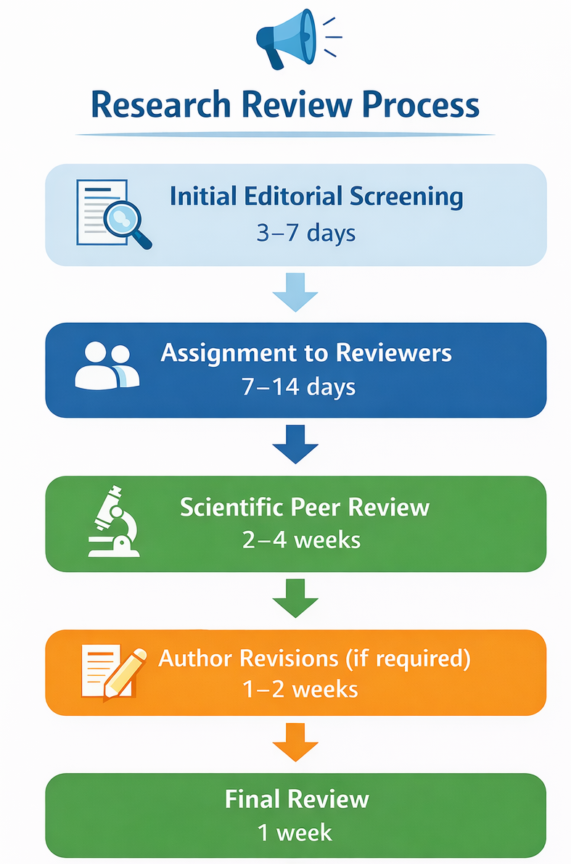
9. Timeline of the Peer Review Process
The journal aims to maintain an efficient and timely peer review process:
- Initial Editorial Screening: 1–2 weeks
- Peer Review Stage: 4–8 weeks
- Revision and Final Decision: Depending on the extent of revisions
10. Confidentiality and Anonymity
All manuscripts and reviewer reports are treated as strictly confidential documents.
- Reviewers must not disclose manuscript content without editorial permission
- Reviewers must not use unpublished materials for personal research or professional advantage
- The anonymity of both authors and reviewers is strictly maintained throughout the review process
11. Ethical Considerations in Peer Review
Editors and reviewers are expected to:
- Declare any conflicts of interest
- Conduct reviews objectively and professionally
- Report suspected ethical misconduct, plagiarism, or research malpractice
The peer review process is conducted in accordance with the ethical principles and best practices of the Committee on Publication Ethics (COPE).
12. Appeals and Complaints
Authors may appeal editorial decisions by submitting a written justification to the editorial office.
Complaints related to the peer review process are handled transparently, fairly, and in accordance with the journal’s ethical policies.
13. Final Acceptance and Publication
Accepted manuscripts undergo copyediting, formatting, and proofreading prior to publication.
Authors are required to review and approve the final proofs before publication.